
Opening Reflection
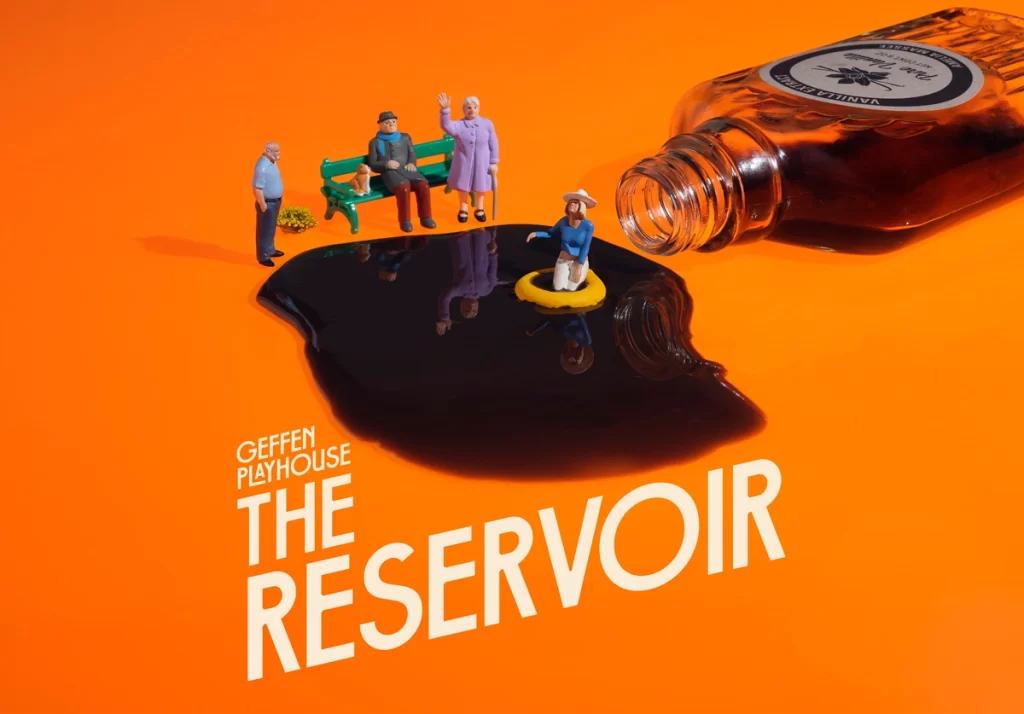
The grand standing ovation was once a pleasant surprise—a hard-earned reward for a performance that truly gripped its audience. To jump to your feet was to say, thank you for moving me. Now, it feels more like an expected obligation, a participation trophy handed out for simply putting on the ritz, as if the price of admission hadn’t already paid the compliment.
But not this time.
I haven’t felt compelled to stand in ovation to a play in quite some time, and The Resevoir written by Jake Brasch at the Geffen broke the streak of mindless monotony for me. Just the type of show I needed right now and one that would’ve made me look like a cheese-ball yelling, bravo! (And I would’ve meant it 😋)
It is the charming, heartwarming and heartbreaking tale of a queer Jewish alcoholic man whose recovery journey is trodden through his desire to reconnect with his grandparents. Set in Colorado between 2013 and 2014, this timeless experience through the protagonist’s mind and moments of reality is filled with delicious, nuanced moments of delight and pockets of hard-hitting realities of life.
Grounded and raw seem like cliche, overused terms to describe theatre these days, but the shattered parts of humanity rang so truly through this piece in a genuine and witty way. The circumstances were so specific, and relatable, unmasking the frail and unforgiving moments of life. It doesn’t tie things up neatly in a bow, it doesn’t pretend that all is forgiven or that there is any closure. It doesn’t pretend that anyone is right, and it doesn’t try to validate and justify any wrongs. It just allows these people to be human, and we witness it. It allows us to be wrong about our perspectives and be proven right. It allows the questions we challenge ourselves about morality and the purpose of living this sentient and cognitive existence to go unanswered. A perfectly, imperfect, human piece of work that was so satisfying and gratifying to all of the senses. And while some of the pieces remain broken as life often is, the play satisfies us and moves us with emotional closure…through love and joy!
Characters & Performances
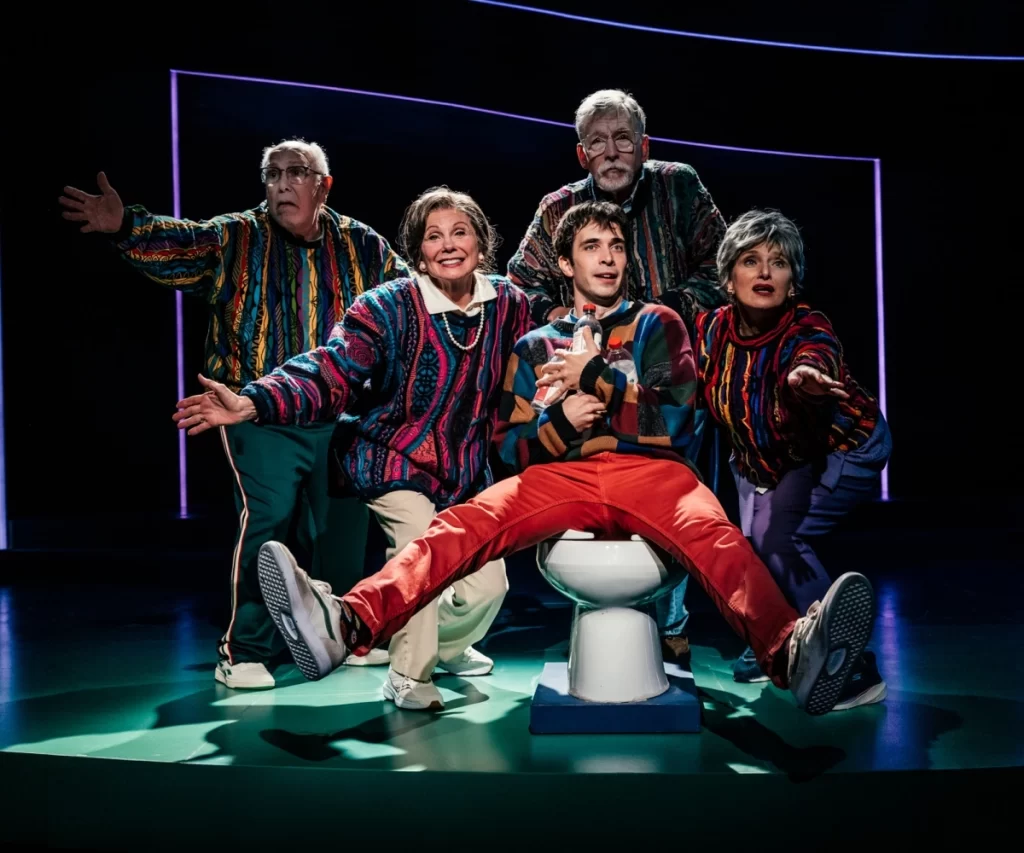
Now, I read a critique online that described the characters, essentially, as one-dimensional, accentuated through sitcom-level witticisms and heightened caricature. However, I disagree. I also could argue that if true, it’s partially the point.
Nuance didn’t matter to Josh, at least not initially, because we were supposed to be completely occupied with his life, his story, and how everyone presented in his mind. After all, he was the main character, as explicitly pointed out at one point in the play.
The way he allowed moments to pass by while we were wrapped up in his spiraling thoughts was a clever demonstration of his anxiety and propensity to spiral. The audience truly got to ride the wave of his reality versus his inner dialogue, with each character acting as a manifestation of his brain’s runaway train of thought. Characters popped in and out through present moments, memories, and ideas because that’s how he processed the world. The people in his life existed as almost peripheral players of his experience, until he slowly began to see them as they were: real, multi-dimensional people deserving of curiosity and presence, not his own projections or conditions.
It’s only when he begins to see them outside of himself that we, too, get to see them as fully realized human beings.
Every character was distinct and so crassly human, reminding us that Grandma, Grandpa, and Nana are just titles. They are people who hurt as much as they were funny, and you loved them deeply despite their flaws. You saw them as who they were beyond the filters of life’s disappointments and challenges. You experienced their pure joys and delights, even in crass memories like being caught masturbating as a teenage boy or wholesome ones, like baking cookies for her grandson. Everyone’s perspectives were so innocent, true, and right, even if you disagreed. You just got it, which is not always easy to write.
Josh – Anxious, adorable, intelligent, earnest and our protagonist played by Jake Horowitz. He is the troubled and flimsy lens through which we travel this story, and he is a mirror for anyone who’s ever been consumed by their own thoughts. Narcissism is often painted as a cruel supervillain twirling his mustache, but never as a well-meaning, traumatized human who is afraid of being alone and unable to see past their own thoughts. That’s what Josh is to me.
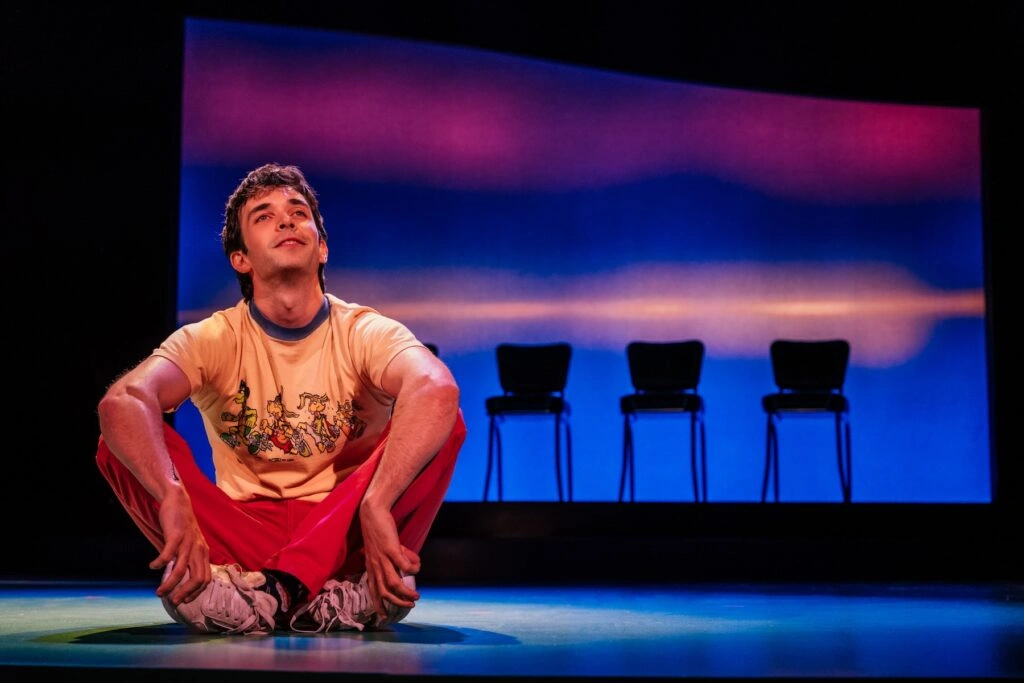
He is seen as selfish by those around him, and yet he remains deeply lovable. People mask their frustration with him out of love. To me, that means they believe he deserves love, even if his head is too far up his own ass to realize the people around him are the main characters in their own lives. “Up his own ass” may sound like an insult, but in this context, it reflects a mind racing so hard it can’t stay present. He devours his own thoughts, his own ego. Everything he thinks is about progress: what’ll get him to the next level, the next revelation. He assumes his perspective is the perspective and that if something makes sense to him, it must function that way in everyone else’s life.
Though seemingly innocent, his worldview is flawed. But it is also painfully relatable. As an ambitious millennial living at the speed of 1,000 mph in a tech-saturated world, I understand what it means to be so consumed with your thoughts and experiences that you forget to value the people around you unless they are useful to your narrative. You assume that the knowledge you’ve just acquired is novel for everyone else. You believe the phase of life you’ve entered is universal truth.
What a blessing to see that kind of flawed mind reflected on stage with such gentle, fair critique. To witness how wrong, small, and incomplete our view of life can be. How fleeting and narrow our epiphanies are. Life is a constant journey of knowing, unknowing, learning, and ultimately accepting that we know very little. Nothing is absolute. It is fragmented, dreamlike, mysterious. It’s simple, and yet complicated. It’s precious, and yet not that big a deal. It hurts, and yet it tastes so good.
You empathize with Josh’s pain and even recognize its validity, but as his grandfather makes clear, it’s no excuse. And yet, none of those racing thoughts truly matter when Josh is sitting with his grandma in a coffee shop, or playing Scrabble with his mom, or shouting out into a canyon. Josh teaches us this as he explores and learns from his grandparents. He reminds us that being present with others is more powerful than any internal monologue. From his first moments onstage, Jake Horowitz draws you in with a quiet magnetism through his understated delivery and casual wit, landing each punchline without fanfare. He anchors the piece with a fun but grounded rhythm, holding the reality of the play even as it drifts into absurdity. His introspection is subtle but hits, and always keeps a hum beneath the surface. It’s a rare kind of restraint in work as an actor, and it’s beautifully executed.
At first, just swirls of Josh’s consciousness (and unconsciousness), and then full, human beings who have a lot to teach us about life, are the wonderful, eccentric, and poignant ensemble characters of the play that I’ll delve into with brief snippets below:
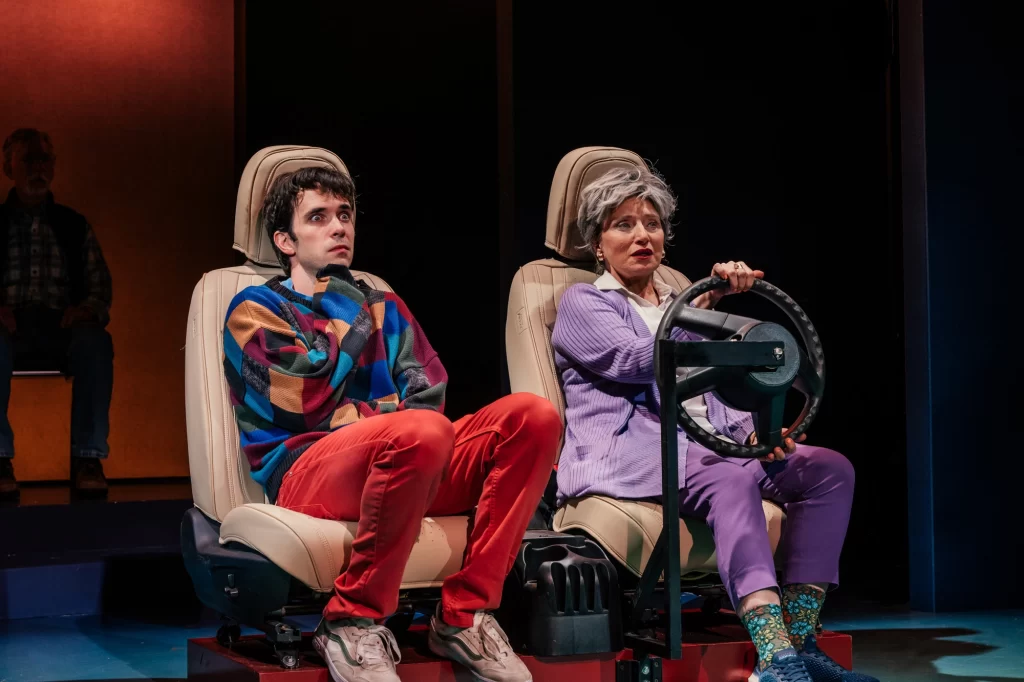
Patricia – Sharp, reserved and loving in her own way, is played by Marin Hinkle. Her legendary Scrabble skills reveal where Josh gets his intellect. She loves him fiercely but doesn’t enable him. Her emotional boundaries are a form of protection and a reminder that parents are human, not repositories for their children’s brokenness. (Oof. That’s a hard pill to swallow. But neither are the children for their parents’ brokenness as we’ll learn too)

We learn how much she loves Josh and her family through her protection without forgiveness. It reminds us how special the relationship between mother and child is across the years and how that bond evolves in adulthood. Could these relationships become friendships? What does that look like, and what responsibility lies with the parent? Do parents get to be their own person, or do we treat them like a vessel we can endlessly pour into as if they owe us their bodies and their space indefinitely? The play doesn’t give us a tidy answer. Instead, it reflects the tension and tenderness that exist when love must coexist with limits. With tender resilience and grounded grit, Marin Hinkle embodied the fragile dance between exhaustion and enduring hope. She also provides comedic puchiness in other various, wacky characters she plays throughout. Such intriguing and lovely work.
Nana – Irene – Sweet and almost childlike, even as she fights her own battles. Her innocence doesn’t shield her from Josh’s criticism. But in her simplicity, she offers a life philosophy that challenges logic: joy in the small things, even when misunderstood. She’s not right or wrong, she just is, but can she accept Josh as who he is as she expects him to accept her? Her presence grants us some tender moments including a lovely conversation in a cornfield in Nebraska that warmed my heart. Played by actress Carolyn Mignini, her charm and cadence flowed like waves in the sea, adding such a lightness and warmth to the world of the play. Beautiful work!

Grandma Beverly – A whole human being: mother, alcoholic, divorced electrical engineer played by Liz Larsen. She’s brash and cynical, yet sincerely loves Josh. She’s also fun, present, real, and wildly intelligent. She may cuss you out, but she’ll still wipe your tears, demonstrating that empathy comes in many forms, not just what’s rosey and sweet and looks good on the surface. Love is much deeper than that and that’s the love that she gives to Josh unflinchingly. In a poignant moment in the play, Josh gets to return the favor. Liz Larsen’s juicy performance reminded me of a lemon: zesty, sharp, and impossible to ignore in the best way. Her delivery had that classic Golden Girls flair, landing every line exactly where it needed to and hitting us in the gut through the decrescendo into warmth. Wonderful work to experience!
Grandpa Hank – A man who reminds us that life doesn’t owe us closure. He lives on his own terms and is steadfast in his perspectives. Even when his decisions seem harsh, they are respected and understood. He teaches us that understanding someone doesn’t mean we have to agree with them. The harshness of his truth stings, but it still lands. And even if you do disagree with him, dislike him, or render the distressing feelings his character gave me, there’s a certain wisdom associated with his roughness that only living more life can grant you and that experiencing more life can allow you to accept.
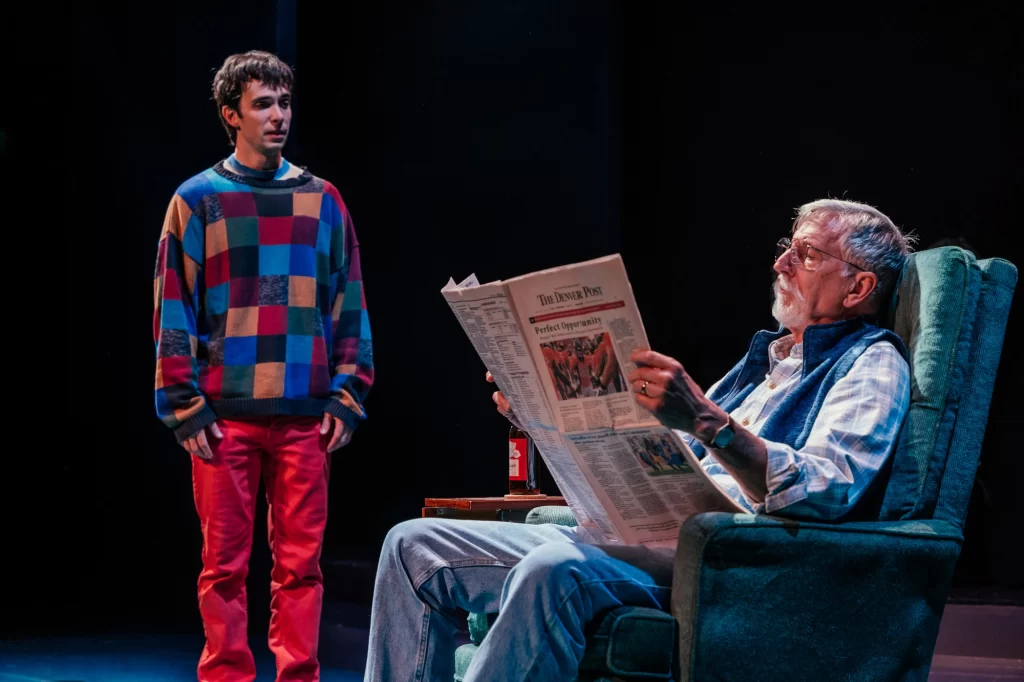
Actor Geoffrey Wade stood with quiet authority laced with a tinge of playfulness. He allowed us to experience the character’s sternness and perceived aloofness through a surprisingly compassionate lens, one that invited curiosity rather than judgment. Hank could easily be a cold character, but Geoffrey’s performance rendered him familiar, like a distant relative or co-worker we’ve all known but never fully understood. He made him tough to read but stick with you even past curtain call. Very well done.
Grandpa Shrimpy – Hilarious, raunchy, endearing. His shocking stories are told with such honesty that they become tender. His effort to reconnect with his Jewish faith, culminating in the repetition of a bar mitzvah prayer at age 83, is one of the play’s most touching scenes, leaving me in tears. It was triumphant, like watching your grandparent become 13 all over again and witnessing what truly matters in a full, long life. What a fun, comical character who exuded fearlessness and joy and really filled my heart with love.

Gifted to us by actor Lee Wikof, his honesty and preciseness left me rolling scene after scene. The words are funny enough, but it’s Lee’s presentness and joy in the work that brings it to life. There’s an energy that Lee brings to the character that makes him flicker whenever he’s onstage, even if he’s just sitting in the chair. I was not only interested in him but moved by him and wanted to join him in Jazzercise class!
Hugo – The subtle supervisor with two-word entrances and quick exits is more than meets the eye. Josh barely notices him until he begins to truly notice others and that’s when some true growth can begin for our protagonist. Adrián González embodies Hugo and other various characters throughout and shifts between the characters so seamlessly. He allowed us to have a sense to a layer deeper to Hugo than is initially presented to us without overcompensating or spoiling the story. Overall, he was fun to watch!

There’s so much juicy complexity in these characters that I could go on. I could truly analyze them for pages, but I’ll stop myself before I give too much away. They are compelling, hilarious, and bring about so many twists and turns that I implore you to uncover them for yourselves!
Set & Technical Design
The set is intentionally fragmented: pieces of rooms, a lamp, a couch, a door. These fragments mimic how memory functions, rarely whole and often blurred. The lighting seamlessly transitions between reality and dream-like states. One standout moment is a fantasy sequence that merges a bookstore bookshelf with a portable bar, showing how seamlessly the mind blurs our desires and the realities of our day into fascinating sequences, trying to interpret and make sense of it all.
These minimal but deliberate set pieces make the abstract journey of Josh’s mind legible without distracting. Even though these are meant to represent the real locations of his experience, they still reinforce the dreamlike, introspective nature of the play, pulling us into his interior world.
Final Thoughts
Some critics might feel fatigued by stories of family dysfunction or internal struggle. But this one felt necessary. The emotional “anty’s” weren’t overindulgent. They enhanced the narrative, making it a ride worth taking. They are the reason we go to the theatre: to feel something larger than life, to remember things about life and ourselves, and to be moved.
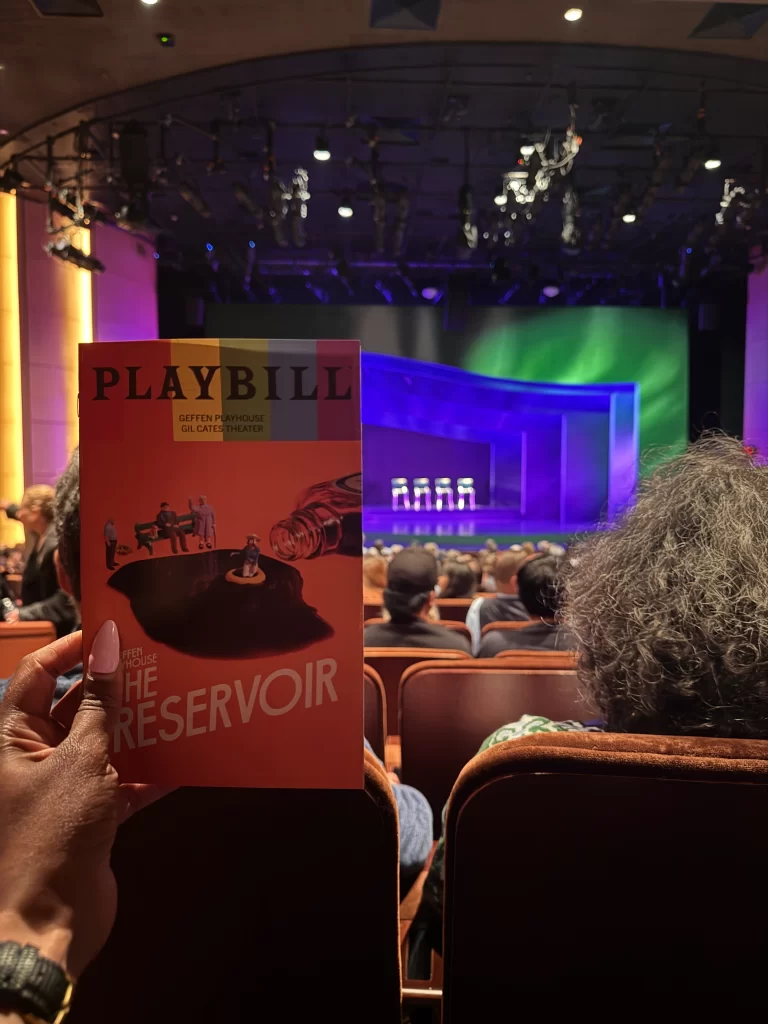
The Reservoir is not just a play—it’s an experience. The clever writing by Jake Brasch coupled with the deft direction by Shelley Butler guide you through every turn with the ease of a strong sitcom, making each shift in tone and emotion feel so natural and alive. When I described it as, “delicious,” before, I meant it. It keeps you on the edge of your seat and hanging on the edge of every word through the last line of dialogue and quiet moments onstage.
This play feels like a hug I didn’t want to end.
Postscript
The week I saw this play, I had prayed for my heart to reopen within the current state of the world and society. I prayed for the knob to turn toward curiosity again. To listen more, not just wait to speak. To see others not just as reflections of me, but as reflections of a world I may never fully understand. To feel a sense of hope in my humanity in a time where anxiety can shut it off. The Reservoir met me right there, at that intersection of knowing and unknowing, and whispered, “It’s okay not to have the answers. Just be here.”
Sometimes the theatre gives us entertainment.
Sometimes it gives us answers.
And sometimes, like this, it gives us joy and peace.